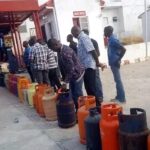


The price of premium Motor Spirit (PMS), also known as petrol, appears headed for N1,500 per litre after it jumped from N1,205 to N1,310 yesterday.
The development came despite a drop in the prices of crude in the international market from $92 per barrel to $87.31.
Checks by Sunday Vanguard showed that MRS, a major downstream player, increased its retail price to N1,310 per litre from N1,205 per litre in Lagos and environs.
The checks further showed that other marketers raised their retail prices to between N1,315 and above N1,400per litre, from N1,205 per litre.
Nigeria’s domestic petrol depot prices, analysts said, continued to move differently from international crude oil benchmarks, highlighting the growing influence of local supply, refining, logistics and market conditions on downstream fuel prices.
According to OilPrice.com, Brent crude stood at $88.10 per barrel, down 0.47 per cent, while West Texas Intermediate, WTI, fell 0.16 per cent to $83.40 per barrel.
However, petrol prices at major Nigerian depots remained elevated, reaching as high as N1,217 per litre in the regions monitored on Friday, August 28, 2026.
The Daily Depot Price Intelligence Report showed that Warri recorded the highest PMS price at N1,217 per litre, followed by Port Harcourt at N1,214, Calabar at N1,204 and Lagos at N1,202 per litre.
The lowest reported PMS price was N1,203 per litre, recorded at Mainland and Soroman depots in Calabar.
In Warri, Liquid Bulk sold petrol at N1,215 per litre, Masters at N1,210, Matrix at N1,217, Sigmund at N1,215 and T.S.L at N1,215 per litre.
In Lagos, Aiteo and Dangote depots were both listed at N1,200 per litre.
The figures indicate that domestic petrol prices are no longer moving in lockstep with international crude oil prices, with other cost factors increasingly determining the price of products delivered to Nigerian depots and ultimately to filling stations.
Although crude oil is a major input in the production of refined petroleum products, changes in crude prices do not translate immediately or proportionately into pump prices.
Other factors include refining margins, product availability, import parity, exchange rates, freight and marine logistics, storage and depot charges, financing costs, taxes and competition among suppliers.
The development also came as locally refined products increasingly competing with imported petroleum products.
At the international level, the market remained mixed. While Brent and WTI declined, Murban crude rose 4.04 per cent to $95.75 per barrel, the OPEC Basket increased 1.06 per cent to $87.31, while the Indian Basket rose 1.53 per cent to $89.52.
The divergence between crude and domestic petrol prices could have significant implications for filling stations, motorists and the wider Nigerian economy.
Where depot prices remain elevated despite softer international crude benchmarks, marketers may face pressure to maintain or increase pump prices to protect margins, particularly where transportation, financing and other operating costs remain high.
This could translate into higher fuel costs for motorists, with knock-on effects on transportation, logistics, food distribution and inflation.
Conversely, stronger competition among domestic refiners and product suppliers could limit the extent to which higher depot prices are passed on to consumers if alternative sources of supply become available.
The latest development therefore suggests that Nigeria’s petrol market is increasingly being shaped by domestic supply, refining capacity, logistics and market structure rather than crude oil prices alone.
As a result, monitoring the relationship between depot and pump prices, as well as regional price differences, is becoming increasingly important in assessing the direction of petrol prices and their wider impact on inflation, transportation costs and the Nigerian economy.