
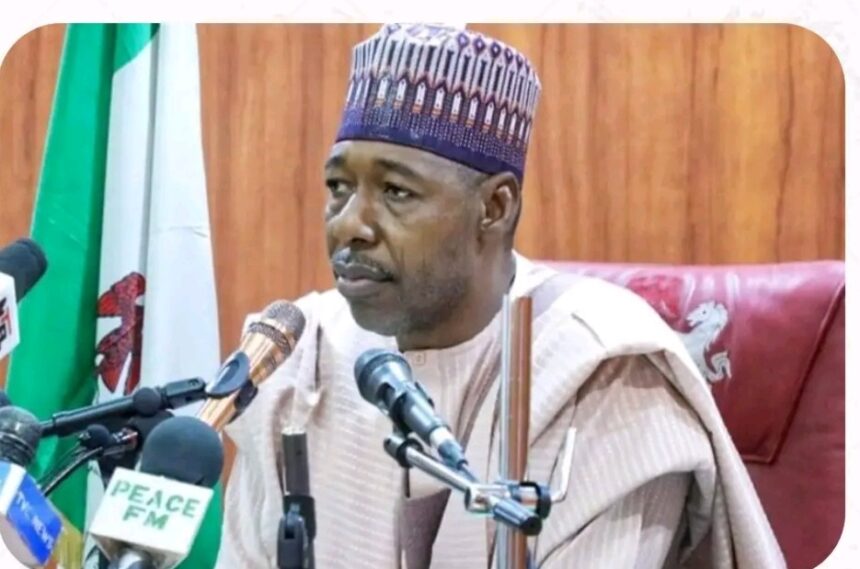
The Borno State Governor, Babagana Umara Zulum, has said the Boko Haram insurgency destroyed more than 5000 school structures in the state and left about 2.2 million children out of school at the peak of the crisis.
Zulum disclosed this in Maiduguri during the commissioning of education and infrastructural development projects.
According to him, fewer than 500,000 children were enrolled in school during the height of the insurgency, while several teachers and school administrators were also killed.
“The insurgency destroyed more than 5,000 school structures, while at its peak, an estimated 2.2 million children were out of school, with fewer than 500,000 enrolled,” he said.
The governor said the reconstruction of schools was not limited to replacing damaged infrastructure but also involved restoring access to education and rebuilding the confidence of communities affected by the insurgency.
“For us, therefore, rebuilding schools goes beyond constructing physical structures. It is about restoring access to education, rebuilding confidence in our communities and providing our children with the opportunity to secure a better future,” Zulum said.
He said his administration spent N46.987 billion on basic and secondary education between the 2025 and 2026 fiscal years.
Zulum said the expenditure formed part of a broader programme involving 136 education and infrastructure projects that had either been completed, were awaiting commissioning or were still under construction.
He said the number of usable classrooms in public pre-primary and primary schools had risen to 5,792, while functional water, sanitation and hygiene facilities increased to 4,563.
The governor also said the number of functional senior secondary schools increased from 34 in eight local government areas in 2019 to 129 in 25 LGAs in 2026.
He said enrolment across schools in the state rose from 766,551 learners in 2019 to 1,801,295 in 2026, representing an increase of more than one million learners.
Zulum attributed the growth to increased access to education, improved public confidence and continued investment in the sector.
On Islamic education, the governor said the state was revitalising the Sangaya system and integrating Islamic studies with science, mathematics, technology and foundational English through the NBAIS-approved curriculum.
He said 25 Higher Islamic Colleges had either been completed or were at advanced stages of development out of the 27 planned across the state.
Zulum added that the government was registering and validating Sangaya centres, facilitators, enumerators and Islamiyya schools to improve planning and support for learners.
He said N13.135 billion had been committed to establishing 25 Digital Literacy and ICT Centres across Borno, with 18 already operational and seven at different stages of completion.
The governor added that N1.4 billion had been spent on computers and solar power in 100 secondary schools to support the transition to computer-based testing.
On technical and vocational education, Zulum said five Vocational Enterprise Institutes had been established, while 11 Vocational Training Centres were reactivated.
He added that three Second Chance Skills Entrepreneurship Schools had also been established for women and girls.
According to him, more than N15 billion had been invested in establishing, rehabilitating and equipping the institutions, as well as providing starter packs and grants to trainees.
Zulum further disclosed that N4 billion had been committed to teacher training and professional development since May 2023.
He said the investment included the recruitment of 5,000 teachers and training of more than 11,000 basic-level teachers.
The governor said the teaching workforce across basic, secondary, technical and vocational education, as well as Sangaya education, now stood at 19,316, representing a pupil-teacher ratio of about 38 learners to one teacher.
The Post Office nine-span flyover in Maiduguri was also commissioned during the event.
Zulum said the flyover was constructed at a cost of N15.959 billion and completed within 11 months.
According to him, the project would reduce traffic congestion, improve road safety and ease the movement of people and goods along one of the city’s major transportation corridors.
The governor also commissioned a 2.5-kilometre dualised road with five kilometres of drainage from Budum Tandari Junction to Kasuwan Shanu.
He said the road was constructed at a cost of N5.003 billion.
Zulum said the education and infrastructure projects were part of his administration’s broader efforts to rebuild the state and create more opportunities for its residents.
“The journey of rebuilding Borno continues, and our commitment remains unwavering: to ensure that every child has access to quality education and the opportunity to build a productive and dignified future,” he said.