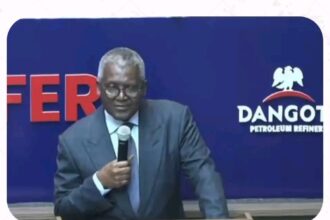

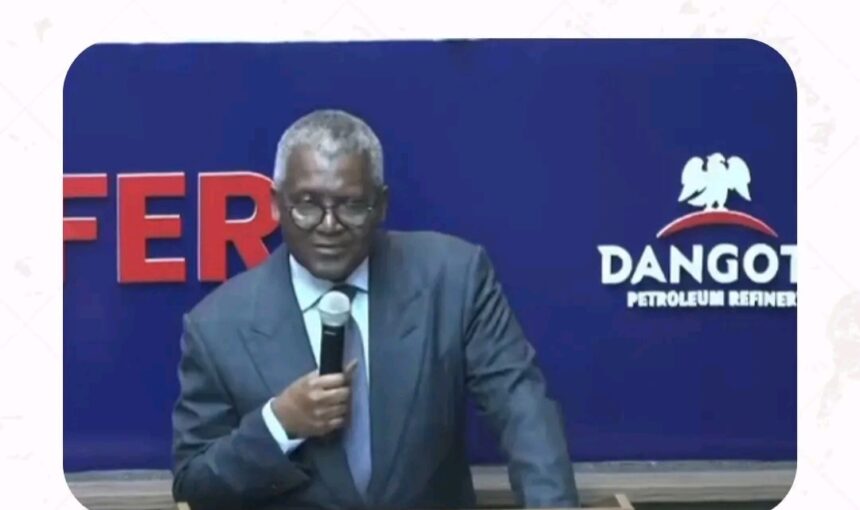
The president of Dangote Industries Limited, Aliko Dangote, has explained why petrol remains expensive in Nigeria, attributing the high cost partly to continued smuggling of the product to neighbouring countries where it sells for significantly more.
Dangote’s explanation comes amid recent reports that petrol prices have climbed to around N1500 per litre in parts of Nigeria, with motorists and consumers expressing concerns over the rising cost of the commodity.
Speaking in an interview aired on Arise TV on Tuesday, Dangote said Nigerians should compare the domestic pump price with prices in neighbouring countries before determining whether petrol is expensive in Nigeria.
He said petrol sells between 30 and 50 per cent higher in some neighbouring countries, creating a strong financial incentive for traders to move the product across Nigeria’s borders.
“You know, expensive is relative. In the sense that today, maybe, you know, a lot of them, there’s ignorance also. What they need to do is ask, what is the neighbour’s price?” Dangote said.
According to him, significant price differences between Nigeria and neighbouring countries have continued to encourage the smuggling of petrol out of the country.
“I don’t know if you know that there’s still a lot of smuggling of the same petrol we are producing to our neighbouring countries,” he said.
Dangote specifically cited Niger Republic, saying petrol there was selling about 20 to 25 per cent above the Nigerian price.
He explained that the price differential makes it financially attractive for traders to purchase petrol in Nigeria and move it across the border for resale.
“And people can now go and ask, okay, fine, what is the price of, even now at N1,350? Okay, the price in Niger is 20 to 25 per cent more than Nigeria,” he said.
He questioned what legitimate business could generate such an immediate return.
“So, what business are you going to do that will make you have an instant 25 per cent return?” he asked.
Dangote alleged that some traders disguise the destination of petrol shipments within Nigeria before diverting the product towards border communities.
“So, it means that, yes, you take the [petrol], you go and take it across the border. You pretend you are taking it to Sokoto, you go and just take it to Ilela, and you sell,” he said.
He said such activities could reduce the volume of petrol available to Nigerian consumers because products intended for the domestic market are diverted to countries where higher prices can be obtained.
The comments come as petrol prices have continued to fluctuate across Nigeria, with recent reports putting the pump price at about N1,500 per litre in some locations.
Dangote, however, said the challenge facing Nigeria’s petroleum market could become bigger than price if the ongoing crisis in the Middle East affects global energy supplies.
He warned that the major concern could shift from how much Nigerians pay for petrol to whether sufficient volumes would be available.
“And the problem now, going forward, I must also warn that this crisis in the Middle East is not even about price; it’s about availability,” Dangote said.
Asked whether Nigerians should be worried about petrol supply, Dangote assured consumers that the Dangote Refinery would continue supplying the domestic market.
“We will deliver to Nigeria. Nigerians don’t need to worry. There will not be any shortage from our own part,” he said.
“There won’t be any shortage. There will not be any queues. We will make sure that we keep satisfying the market, despite all odds,” Dangote added.
His comments came as investors flooded the Nigerian Exchange on Monday following the commencement of the initial public offering of Dangote Petroleum Refinery and Petrochemicals.
The N2.15 trillion IPO was formally opened during the opening gong ceremony at the NGX trading floor in Marina, Lagos, with Dangote sounding the gong to mark the commencement of the offer.
The refinery became the first petroleum refinery to be offered to investors on the Nigerian stock market in the Exchange’s 66-year history.
The IPO comprises 4.1 billion ordinary shares offered at N525 per share, with a minimum subscription of 10 shares valued at N5,250.
The offer is open to retail, institutional and eligible African investors and is scheduled to close on October 13, 2026.